I have been fascinated by public market investing for as long as I can remember. It’s part of the reason I loved it when my colleague Daniel suggested we launch the Flybridge AI Index a few years back. The source of my fascination? It started at the family dinner table.
My father founded the public equity investment firm Westfield Capital Management and served as its first CEO for years. He was an investor for more than seventy years — a number that still astonishes me — and he died this past June, just shy of his 95th birthday. He brought relentless curiosity, a deep contrarian streak, and a competitive spirit to everything he did. He loved the markets. Not the scoreboard, the markets: the puzzle of them, the argument of them, the potential opportunities, and the daily proposition that you might be right or wrong. He showed me that what you do professionally ought to bring you joy.
I went into venture instead of public equities as I wanted to be closer to the action and loved working with founders every day, but I never stopped reading what the great public investors write. And of everything my father modeled, the contrarian streak is the part I think about most in my own work. VCs say “non-consensus and right” so often it has lost its impact. He actually lived it, cheerfully, for seven decades, and he was very clear that being alone with a high-conviction view for a while was the whole job, no matter how uncomfortable. In fact, he relished in the discomfort.
So I enjoy studying public-market writing because investors in public markets have been thinking rigorously about judgment under uncertainty for much longer than we VCs have.
The list
On a recent day off, I re-read Michael Mauboussin’s “Ten Attributes of Great Fundamental Investors.” Mauboussin is a rock star in a field that does not produce celebrities — clear, original, unusually honest about what he does not know. If you want to go deeper, his book is coming out soon.
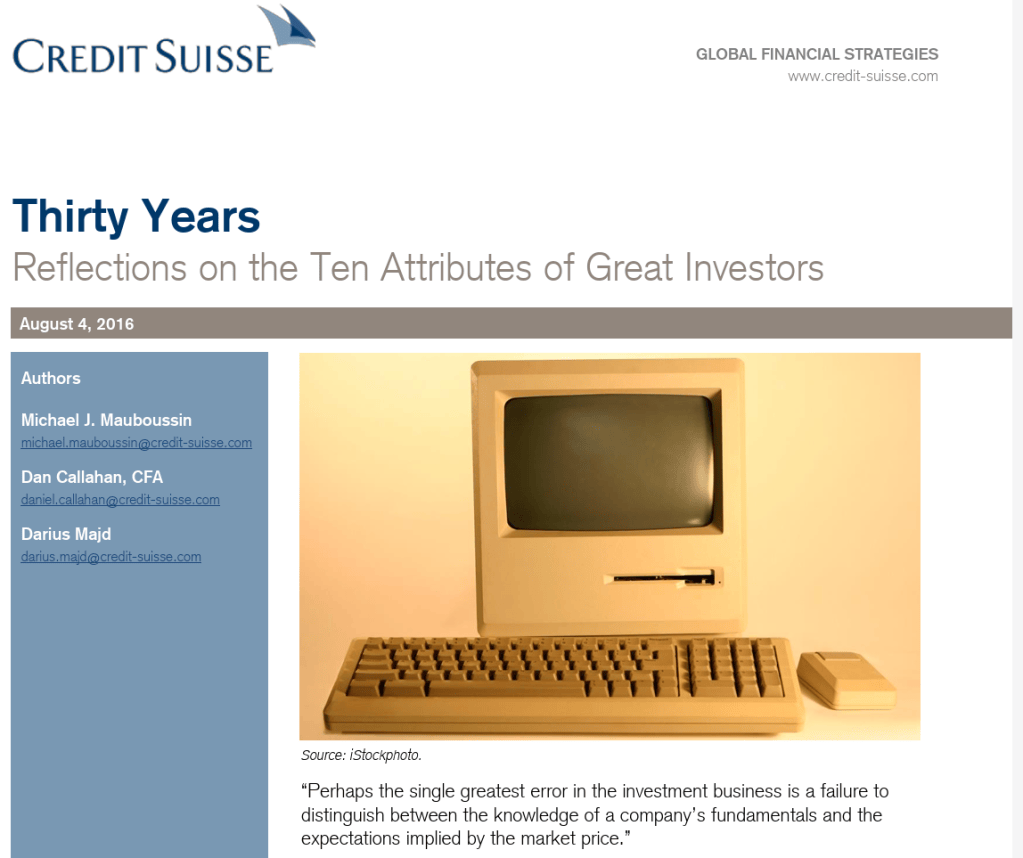
His ten attributes are: be numerate; understand value; properly assess strategy; compare effectively; think probabilistically; update your views; beware behavioral biases; know the difference between information and influence; size positions properly; and read widely with an open mind. I have always found this list excellent. Yet, for early-stage VCs, easy to skim past.
Another rock star investor/writer is Howard Marks of Oaktree Capital Management (his Best of Collection here is definitely worth a read). I found his latest memo on AI helpful as I sought to translate Mauboussin’s attributes into something actionable as a venture investor. Marks’ long-held view is that readily available quantitative information about the present cannot produce superior returns, because everyone has it. In the AI era, everyone has it and the machine processes it better than they do. What is left, he argues, is judging what information implies, assessing qualitative factors like management and innovation, and divining futures. I would add a fourth: operating in ambiguity, where there are no facts and no patterns to extrapolate from at all.
That fourth one is a description of our day job.
The Venture Translation
It is so easy to gloss over the Ten Attributes, and my early-stage VC colleagues might argue that public investing lessons aren’t particularly relevant for our work. First, Mauboussin’s list understates the importance of the founding teams we choose to back in driving outcomes. Teams still matter in the public markets, but all you have in a start-up is the founders and their vision and capabilities. There is no comparison in the relative importance of backing the right people. This is especially true in the AI era of massive dynamic changes on a seemingly daily and weekly basis, so the predictive value of today’s business plan falls while the predictive value of the team’s ability to adapt rises. Second is access. Public investors can buy any security they want at the closing price. We cannot.
Those are important considerations. Factoring them in alongside Mauboussian’s list, here is my personal translation, “Twelve Attributes” of a great venture investor:
Be numerate. Financial statement analysis of a company with no operating history is theater. What matters is terminal value, ownership, reserves, dilution, and power-law math. The question is never “is this a good company.” It is “if we are right, does this return a meaningful portion of the fund?” and the best VCs deeply internalize the importance of Power-Law. AI will do this arithmetic faster than any of us in Excel. The edge is knowing intuitively when the arithmetic doesn’t add up.
Understand value creation, not today’s valuation. Every venture deal looks expensive at entry. Discounted cash flow models are useless as uncertainty is enormous and terminal value dominates. The real question is how much economic value this company could ultimately create and how much accrues to our ownership: TAM, share, margins, capital intensity, dilution, exit multiples, stated explicitly. And this is not only analysis. It also impacts access. An investor who can articulate “here is how this becomes a $10B company” is magnetic to an ambitious founder, especially when they see something the founder believes, and the market does not yet.
Assess strategy — meaning, why this becomes exceptional. “Great founder, huge market” is pablum. A VC must trace the throughline from the founder’s insight to the product to customer value to distribution to compounding advantage to durable moat. AI erodes technical differentiation faster than most decks assume, so compounding matters more than the current growth curve. Curiosity about and creative engagement with founders across these areas transitions the dynamic from “founder pitching a VC” to “founder and VC discover something together” and if the founder leaves thinking differently about her own business, you have demonstrated value before you invested a dollar.
Compare effectively — consensus versus reality. Hot markets reliably produce companies everyone agrees are exceptional. Universal agreement is not an edge. Edge is: what do I believe that other sophisticated investors do not? A view on market size, an earned secret the founders have that nobody is pricing, a technical trend that becomes a tailwind. This is the difference between a good company and a good investment, and it pays a second way: a differentiated thesis becomes a magnet for exactly the founders you want to meet.
Think probabilistically, with explicit base rates. “This could be massive” is not an analysis. A probability distribution across failure, modest, good, great, and exceptional outcomes, with the reasons and magnitudes attached to each, is. Then compare it to the base rate for the venture universe and defend why this company should beat it (an example base rate for seed investors would be the Series A graduation rate). Probabilistic thinking also applies to sourcing: the reflex to pass on the strange thing that does not match patterns is expensive. “This looks weird, 80% chance it fails, and the 10% case is extraordinary” is a reason to lean in, not away.
Update aggressively. We see dozens of new opportunities a month, which rewards reaching a glib, smart-sounding conclusion fast. With existing portfolio companies, we are close to the team, invested emotionally as well as financially. Both are perfect conditions for confirmation bias. Every revisit is a chance to update the distribution, not to relitigate whether we were right. The most underrated version of this is the process of passing. Write down what would have to become true to change your mind, then actually track it. That is how you arrive at the next round with a prepared mind.
Fight venture-specific biases with process. We VCs have all the standard cognitive failures plus a few unusually potent ones: FOMO, social proof, recency, facile pattern matching, and price insensitivity. These produce the herd behavior our industry is famous for, and it extends to sourcing — we are nearly all fishing the same three ponds of elite universities, antsy operators from hot companies, and accelerators. A good investment process names these biases out loud in the room. A good sourcing process asks: where would we look for exceptional founders if we ignored the standard VC playbook?
Know the difference between information and influence. Great investors don’t get sucked into the vortex of influence and should not care what others think. While other investors can provide valuable information, their opinions can also be unconsciously influential. In venture, it shows up most often as the easy reference call to an existing investor, or to someone already committed to the round. The first is talking their book; the second wants to be seen as smart and early. Neither is a source of information; both are sources of influence. VCs keep making those calls anyway, because they are easy and they feel like work, but not work that leads to better decisions. Many of us on the venture side have years of relationship history across industries; it’s a perk of the job to know so many smart people. So instead of being influenced, seek out real information by engaging people who are operating in the arena and have real opinions grounded in experience
Let position size accrue over time. Finding edge is only half of it; capturing it is the other half. In venture, that means two questions — should we invest, and how much should we own? Highest-conviction names should consume more fund capital. But true conviction at the earliest stage is rare and mostly counterfeit, so maximum position size should be reached over time, as evidence accumulates and each follow-on outcompetes a new investment for the same dollar.
Be curious — and build differentiated mental models. Multidisciplinary curiosity is a real source of alpha in venture, and great investors develop unusual models of how the world might change. Voluminous long-form reading is necessary yet insufficient. What compounds is a network of people who see the future before you do: researchers, engineers, product leaders, open-source maintainers, former founders. It also feeds sourcing directly. Become genuinely knowledgeable in an emerging field, and the people building in it start calling you.
As noted above, my additions to Mauboussin’s list of ten are the two that most determine venture outcomes.
Eleven: judging the people. As the environment gets more dynamic, the predictive value of today’s plan falls, and the predictive value of the team’s ability to adapt rises. So the central assessment is rate of learning, quality of thinking, adaptability, velocity, talent magnetism, ambition, resilience, and self-awareness. Note that these are all rates, not states, which is why they are best observed over time — and why compressed decision processes so reliably produce mediocre teams in the portfolio.
Twelve: access. Public investors can buy any security they want at the market price. We cannot. We need the company we selected to select us back. The world’s finest analyst will be a mediocre venture capitalist if the best entrepreneurs never enter the funnel, or consistently choose someone else. Every firm should be able to finish this sentence honestly: exceptional founders seek us out before they need capital because ______, where the blank is a highly specific structural advantage that is hard to copy. If you cannot finish it, you do not have one.
Three kinds of alpha
Which means great venture investors generate returns in three ways, and need all three:
Recognition alpha. Can I see exceptional people and opportunities before others do?
Access alpha. Do exceptional founders disproportionately enter my opportunity set?
Conversion alpha. When I recognize one, can I get them to choose me — and own enough for it to matter?
Mauboussin’s list, translated, gets you the first. It is silent on the second and third. And that is the difference between the two investment practices. The public investor’s challenge is being right. Ours is being right and being chosen.
After three decades in this business, I have concluded that the best VCs, investing across multiple cycles, are genuinely both: real investors with real analytical rigor, and people with differentiated positions and visions compelling enough that desirable founders find them. Neither half is sufficient. Plenty of sharp analysts in this industry never see the deals that matter, and plenty of well-connected people see everything and pick badly.
My father would have found the access problem interesting, and irritatingly unfair. He would also have pointed out that the contrarian part translates perfectly.